
In any high-specification laboratory, the movement of fluids is rarely just about "flow." It is about precision, chemical compatibility, and maintaining the integrity of the sample. Choosing the wrong pump can lead to catastrophic equipment failure, contaminated results, or unsafe working conditions.
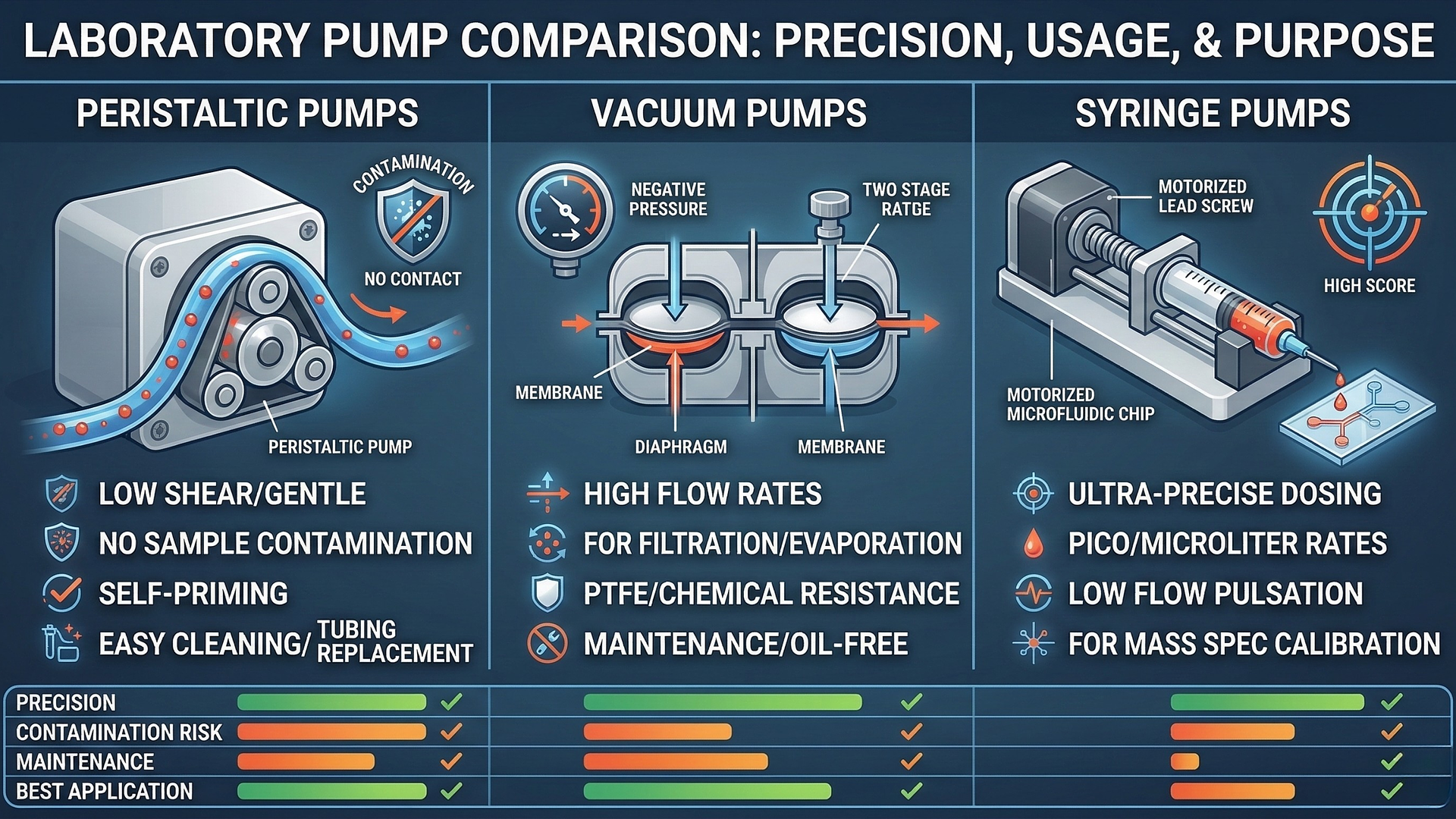
This guide explores the primary categories of laboratory pumps, their mechanical advantages, and their specific applications in research and production.
1. Peristaltic Pumps: The Standard for Contamination-Free Flow
Peristaltic pumps are the go-to solution for maintaining sterility. The fluid never touches the pump mechanism itself; it is contained within flexible tubing that is compressed by rotating rollers.
- How they work: Rollers squeeze the tubing, creating a vacuum that "pushes" the fluid forward.
- Key Advantages: Low shear (gentle on cells), self-priming, and extremely easy to clean (just replace the tubing).
- Best For: Cell culture, chromatography, nutrient dosing, and handling corrosive chemicals.
2. Vacuum Pumps: Powering the Lab Infrastructure
Vacuum pumps are the workhorses of the lab, essential for filtration, evaporation, and drying processes. They are generally categorized into two types: Oil-sealed (Rotary Vane) and Dry (Diaphragm).
- Rotary Vane Pumps: Offer high ultimate vacuum levels. Ideal for vacuum ovens and freeze dryers (lyophilization). They require regular oil changes to maintain performance.
- Diaphragm Pumps: These are "dry" pumps, meaning no oil is used. They offer excellent chemical resistance and are perfect for rotary evaporators and vacuum filtration.
- Usage: Solvent recovery, degassing, and creating a controlled atmosphere.
- {Link to our Vacuum Pumps here}
3. Syringe Pumps: Ultra-Precise Micro-Dosing
When your application requires the delivery of microliters over several hours, a syringe pump is the only viable option. These use a motorized lead screw to push a syringe plunger at a highly controlled rate.
- Precision: Capable of delivering flow rates as low as picoliters per minute.
- Applications: Mass spectrometry calibration, microfluidics, and targeted drug delivery research.
4. Centrifugal Pumps: High Volume, Low Pressure
While less common in analytical chemistry, centrifugal pumps are vital in pilot plants and large-scale liquid transfer.
- Mechanism: Uses a rotating impeller to create centrifugal force, moving fluid at high speeds.
- Limitation: They are generally not self-priming and are not suitable for high-precision dosing or high-viscosity fluids.
- Best For: Water baths, cooling loops, and bulk chemical transfer.